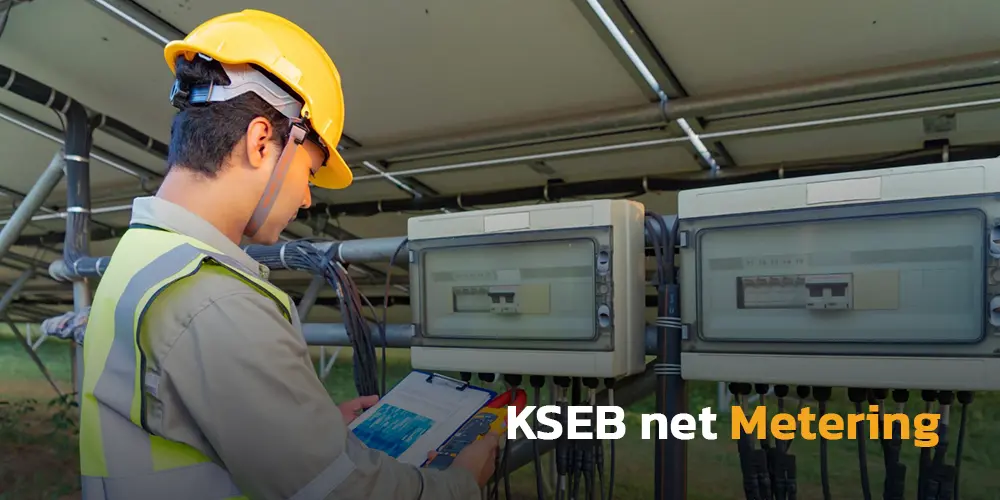
Net metering is the policy that lets your solar panels work for you even when the sun isn't shining. Here's the simple version: when your solar system produces more electricity than your home is using, that surplus gets pushed into the KSEB grid. In return, your electricity bill gets credited for every unit you export.
Think of it as a bank account for electricity. You deposit units during the day when your panels are running full tilt. You withdraw those credits at night when you're running lights, fans, and the TV. The KSEB bidirectional meter records both flows separately and your bill reflects the net difference.
In 2026, with electricity tariffs having risen and solar panel costs having dropped to their lowest point in a decade, net metering in Kerala has genuinely become one of the smartest household investments you can make. A well-sized 3 kW system on an average Kerala roof can bring your ₹2,500–₹3,500 monthly electricity bill down to near zero within a few years of installation.
Who is Eligible for KSEB Net Metering in 2026?
KSEB net metering policy covers a wide range of consumers, but there are a few specific conditions you need to meet before applying. Here's a clean breakdown:
| Consumer Category | Max Allowed Capacity | Single / Three Phase | Eligible? |
|---|---|---|---|
| Domestic (LT I) | Up to sanctioned load (max 5 kW) | Single phase | ✔ Yes |
| Domestic (LT I -larger) | Up to 25 kW | Three phase | ✔ Yes |
| Commercial (LT IV/V) | Up to 500 kW | Three phase | ✔ Yes |
| Industrial (LT VI) | Up to sanctioned load | Three phase | ✔ Yes |
| Agricultural (LT VII) | Limited — check with KSEB section | Either | ✔ Conditional |
| Temporary / construction connection | — | — | ✘ No |
| Consumers with dues / arrears | — | — | ✘ Not until dues cleared |
Documents Required for KSEB Net Metering Application
Getting your documents right the first time saves you weeks. KSEB's application system now validates documents at upload - so incomplete submissions get bounced immediately. Here's the complete checklist:
| Document | Purpose | Format | Mandatory? |
|---|---|---|---|
| Latest KSEB electricity bill | Consumer number & connection details | PDF / Clear photo | Mandatory |
| Property ownership document | Confirm you own the installation site | PDF / Scan | Mandatory |
| Aadhaar Card (consumer) | KYC / identity verification | PDF / JPEG | Mandatory |
| Single-line diagram (SLD) | Electrical layout of solar system | PDF (signed by contractor) | Mandatory |
| Solar installer's MNRE certificate | Proves installer is empanelled | Mandatory | |
| Net Metering Application Form | Official application | Signed PDF | Mandatory |
| Technical specifications sheet | Panel & inverter model, capacity, rating | PDF from manufacturer | Mandatory |
| Site photograph (roof & panels) | Visual confirmation of installation | JPEG (min 1 MB) | Mandatory |
| CA certificate (load calculation) | Required for commercial/industrial | Commercial / Industrial only | |
| Tenancy / NOC from landlord | If you are a tenant, not owner | Notarized PDF | If rented |
KSEB Net Metering Application Process: All 8 Steps (2026)
KSEB has streamlined the net metering process significantly since 2024. The online portal at KSEB Self Service Portal (SSP) now handles most of the workflow digitally. Here's exactly what you need to do, in order:
1. Choose an MNRE-Empanelled Solar Installer
Before you apply to KSEB, you need a solar installation contractor who is empanelled with the Ministry of New and Renewable Energy (MNRE). KSEB will reject applications from non-empanelled installers.
- Check MNRE's empanelled vendor list at mnre.gov.in
- Ask for their MNRE registration certificate (valid in 2026)
- Get a written quotation with full system specifications
- Ensure inverter is grid-tied (not off-grid) with anti-islanding protection
2. Register / Login on KSEB Self Service Portal
All net metering applications in 2026 go through the KSEB Self Service Portal (SSP). If you already pay your KSEB bill online, you probably already have an account.
- Visit KSEB Self Service Portal (SSP).
- Register using your Consumer Number from your electricity bill
- Verify with your registered mobile number (OTP)
- Navigate to: Services → Renewable Energy → Net Metering Application
3. Fill and Submit the Net Metering Application Form
The online form asks for details about your connection and the proposed solar system. Have all your documents ready before starting - the form times out after 30 minutes of inactivity.
- Consumer number, name, address as per KSEB records
- Proposed solar system capacity (in kW)
- Make and model of solar panels and inverter
- Name and registration number of your MNRE installer
- Upload all mandatory documents (see checklist above)
6. KSEB Issues Technical Feasibility Certificate (TFC)
If the inspection goes well, KSEB issues a Technical Feasibility Certificate - their green light to proceed with installation. You'll receive this via email and it will also appear in your SSP portal.
- Check approval status in your SSP portal
- TFC specifies the approved capacity (which may differ from what you applied for)
- If the DT serving your area is near capacity, KSEB may reduce approved capacity - follow up with your section office
- TFC is valid for 6 months - complete installation within this window
7. Solar Installation + Commissioning Test
With the TFC in hand, your MNRE installer can now physically install the solar panels, mounting structure, inverter, and AC/DC wiring. Once done, they conduct a commissioning test in your presence.
- Ensure all panels are properly grounded and earthing is tested
- The inverter's anti-islanding function must be verified and documented
- Your installer submits the Installation Completion Certificate to KSEB
- Don't connect to the KSEB grid yet — wait for the bidirectional meter
8. Bidirectional Meter Installation — You're Live!
The final step. A KSEB team visits your premises to replace your existing meter with a bidirectional (net) meter that records both import and export separately.
- You pay the bidirectional meter cost at this stage (approx. ₹5,000–₹7,000)
- KSEB records the initial meter readings — keep a photo for your records
- They issue you a Net Metering Agreement document — sign and retain your copy
- Your system is officially live and your next bill will reflect net metering credits
Full Cost Breakdown: What You'll Actually Pay
Beyond the solar system installation cost itself, net metering comes with a few KSEB-specific charges. Here's everything, with 2026 approximate figures:
| Cost Item | Approximate Amount | Paid To | When |
|---|---|---|---|
| Application Processing Fee | ₹500 – ₹1,000 | KSEB (online portal) | At application |
| Bidirectional Net Meter Cost | ₹5,000 – ₹7,000 | KSEB | At meter installation |
| Solar System Installation (3 kW) | ₹1,20,000 – ₹1,60,000 | MNRE Installer | After TFC received |
| Electrical Contractor (SLD, wiring) | ₹5,000 – ₹10,000 | Licensed electrician | Before application |
| Annual maintenance (optional) | ₹3,000 – ₹6,000/year | Solar service provider | Ongoing |
| Total (3 kW system, all-in) | ₹1,30,000 – ₹1,75,000 | — | — |
PM Surya Ghar Subsidy + KSEB Net Metering in 2026
The PM Surya Ghar Muft Bijli Yojana (launched in 2024 and still active in 2026) combines beautifully with net metering. You get a central government subsidy to reduce installation cost and net metering credits to reduce your monthly bill.
| System Capacity | PM Surya Ghar Subsidy | Est. Annual Savings (Net Metering) | Payback Period |
|---|---|---|---|
| 1 kW | ₹30,000 | ₹6,000 – ₹9,000/year | 8–10 years |
| 2 kW | ₹60,000 | ₹12,000 – ₹18,000/year | 5–7 years |
| 3 kW | ₹78,000 | ₹18,000 – ₹26,000/year | 4–6 years |
| 4 kW – 10 kW | ₹78,000 (capped) | ₹24,000 – ₹80,000/year | 4–7 years |
How KSEB Calculates Your Net Metering Bill
Understanding your bill after net metering is activated is important — and more straightforward than most people expect.
The Core Formula
Your KSEB bill = (Units imported from grid × applicable tariff rate) minus (Units exported to grid × ₹3.05/unit feed-in tariff for domestic)
| Scenario | Units Imported | Units Exported | Net Bill Result |
|---|---|---|---|
| Heavy export month (summer) | 150 units | 280 units | Credit carried forward |
| Balanced month (normal) | 200 units | 180 units | 20 units billed at tariff |
| Low solar month (monsoon) | 350 units | 90 units | 260 units + minimum charges |
10 Tips to Avoid KSEB Net Metering Rejection
From years of helping Kerala homeowners, these are the most common reasons applications get rejected or delayed — and how to sidestep them:
1. Never use a non-MNRE installer. This is the #1 rejection reason. Verify their certificate before signing any contract.
2. Don't exceed your sanctioned load. If your sanctioned load is 3 kW, apply for 3 kW or less — not more.
3. Clear all pending KSEB dues first. Even a small balance can hold up your application indefinitely.
4. Ensure your single-line diagram is signed by a licensed electrical contractor, not just any electrician.
5. Use only BIS/MNRE-approved panels and inverters. Off-brand or uncertified equipment fails the inspection every time.
6. Be present (or have your installer present) during the inspection. Missed appointments push you back 15–20 days.
7. Double-check your property documents match your KSEB account name. Mismatches cause verification delays.
8. Ensure your main switchboard and wiring are in good condition. Old or unsafe wiring can fail the inspection even if your solar system is perfect.
9. Don't install before receiving the TFC. Starting installation before approval can result in the entire application being rejected.
10. Keep digital copies of everything. Receipts, certificates, inspection reports — store them in a folder. You'll need them for the subsidy claim.
Take advantage of government subsidies and reduce your electricity bills with rooftop solar.
Get Free Consultation