Thousands of Kerala homeowners and business owners are watching their monthly electricity costs climb - not because they're using more power, but because KSEB tariff rates have been revised multiple times in recent years. The slab structure means the more you use, the more you pay per unit and it adds up fast.
Here's the thing though: Kerala has one of the best solar energy potentials in India. With 5 to 6 peak sun hours daily across most districts and a robust government subsidy programme still in place, switching to solar isn't just an environmental choice anymore. It's a financial one.
Let's break down exactly how solar reduces your KSEB bill - and why more Kerala families are making the switch every month.
Why Your KSEB Bill Keeps Going Up
KSEB follows a tiered tariff system for domestic consumers. The first 50 units cost less per unit, but once you cross 100, 200, or 300 units, the rate per unit shoots up significantly. Add fixed charges, fuel surcharge, and meter rent - and a household consuming 250–300 units a month can easily pay ₹2,000 to ₹3,500 or more.
The problem gets worse in summer months and during monsoons when most people rely heavily on fans, ACs, and appliances around the clock.
Solar directly attacks this problem at the root.
How Solar Panels Reduce Your KSEB Bill
1. Generate Your Own Power During Peak Hours
Solar panels produce electricity between roughly 8 AM and 5 PM - which happens to be when most of your heavy appliances (refrigerators, washing machines, TVs, ACs) are running. Instead of drawing from the KSEB grid, you draw from your rooftop.
A typical 3 kW solar system in Kerala can generate 10 to 12 units per day. That's 300–360 units per month, which covers the electricity consumption of a mid-sized Kerala household almost entirely.
2. KSEB Net Metering - Get Credit for What You Don't Use
Here's where it gets genuinely exciting. If your solar panels produce more electricity than you consume at any given moment, that surplus goes back into the KSEB grid. KSEB then credits you for those units through a scheme called net metering.
At the end of the billing cycle, you're only charged for the net units consumed (what you used minus what you exported). In many cases, homeowners with well-sized systems end up with bills below ₹100 per month - sometimes zero.
KSEB has an active net metering policy, and the application process, while slightly paperwork-heavy, is manageable — especially when your solar installer handles it for you.
3. Protect Yourself From Future Tariff Hikes
KSEB tariff revisions aren't going to stop. They've happened consistently, and with Kerala's energy demand growing, future hikes are a matter of when, not if. Once you install solar, your cost per unit from your own system stays flat for 25+ years (the typical lifespan of quality solar panels). You've essentially locked in a large portion of your electricity at today's cost - actually, at zero cost.
Benefits of Solar Energy in Kerala: Beyond Just the Bill
Kerala's Climate Is Built for Solar
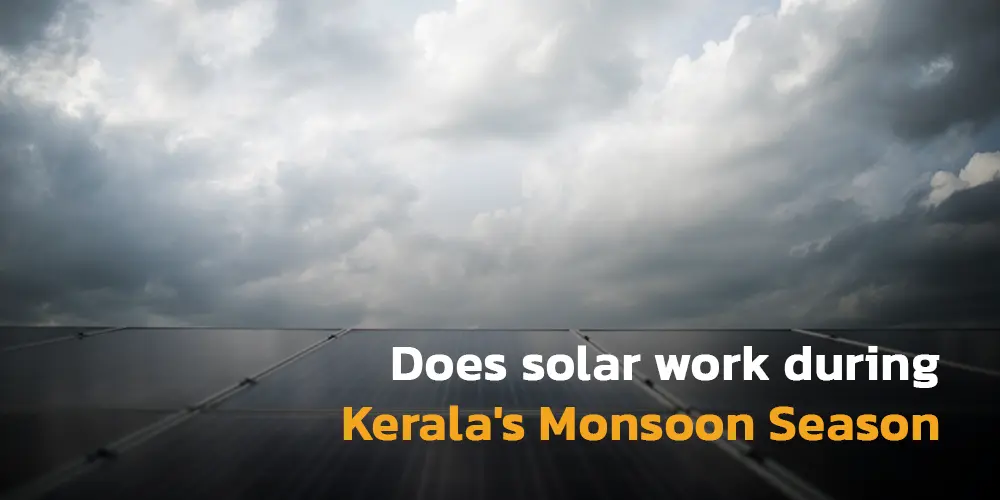
People often assume Kerala's monsoons and cloud cover make solar a bad idea. That's a misconception. Solar panels work with diffused light too, not just direct sunlight. Even on overcast days, they produce 20–50% of their rated output. And during the long, sunny pre-monsoon and post-monsoon seasons, they perform at full capacity. Annual solar irradiance in most Kerala districts comfortably supports viable rooftop systems.
Government Subsidies Reduce Your Upfront Cost
The central government's PM Surya Ghar Muft Bijli Yojana (launched 2024) offers subsidies up to ₹78,000 for residential rooftop solar systems up to 3 kW. Kerala also has state-level support through ANERT (Agency for Non-conventional Energy and Rural Technology). These subsidies directly lower the system cost you pay — making the payback period shorter.
For a typical 3 kW system in Kerala, after subsidy, the net investment often ranges between ₹1.2–₹1.6 lakhs. With monthly KSEB savings of ₹1,500–₹2,500, most homeowners recover this cost within 4–6 years. After that, the electricity is essentially free.
Increase Your Property Value
Homes with installed solar systems command higher resale values. It's a documented trend in urban and semi-urban Kerala markets. Buyers actively look for solar-equipped homes — it signals lower running costs, modern infrastructure, and environmental responsibility.
Environmental Impact That's Actually Local
Kerala faces real environmental pressures — erratic monsoons, rising temperatures, coastal erosion. Every rooftop solar system offsets approximately 2–3 tonnes of CO₂ per year. Over 25 years, that's the equivalent of planting over a thousand trees from a single home. When you choose solar, you're not just saving money — you're contributing to a state that deserves a cleaner future.
Energy Independence During Power Cuts
With a solar + battery storage system, you get an added benefit: backup power during outages. For areas in Kerala that still experience occasional load-shedding or grid failures during storms, a solar battery system keeps your essential appliances running — no generator, no noise, no fuel costs.
How Much Can You Actually Save? A Real Example
Take advantage of government subsidies and reduce your electricity bills with rooftop solar.
Get Free Consultation
Let's take a household in Thrissur consuming 280 units per month, with a monthly KSEB bill of around ₹2,800.
- System installed: 3 kW rooftop solar
- Monthly generation: ~330 units
- Monthly grid consumption: ~0 units (or minimal with net metering credits)
- New KSEB bill: ₹100–₹200 (fixed charges only)
- Monthly savings: ₹2,500–₹2,700
- Annual savings: ₹30,000+
- System payback period: ~5 years (after subsidy)
Over 20 years, that's ₹6 lakh+ in savings — from a one-time investment.
What to Look for When Choosing a Solar Installer in Kerala
Not all solar companies are the same. Before signing anything, check:
1. MNRE empanelment - Your installer must be registered with the Ministry of New and Renewable Energy to avail government subsidies.
2. Tier-1 panel brands — Look for panels from established manufacturers with at least 25-year performance warranties.
3. Local service track record — An installer with roots in Kerala will be there when you need post-installation support, not just during the sale.
4. Turnkey net metering assistance — The best installers handle the KSEB application process on your behalf.
5. Transparent pricing — Get a detailed quote that breaks down panel cost, inverter, installation, and any additional charges separately.
At Best Solar Kerala, we've helped hundreds of Kerala homeowners and businesses make this transition — with full subsidy processing support, quality-assured installations, and post-installation service you can actually reach.
Ready to See How Much You Can Save?
The best first step is a simple roof assessment and consumption analysis. Based on your current KSEB bill and your roof's orientation and area, a good solar consultant can tell you exactly what system size you need, what it'll cost after subsidies, and how many months it'll take to pay for itself.