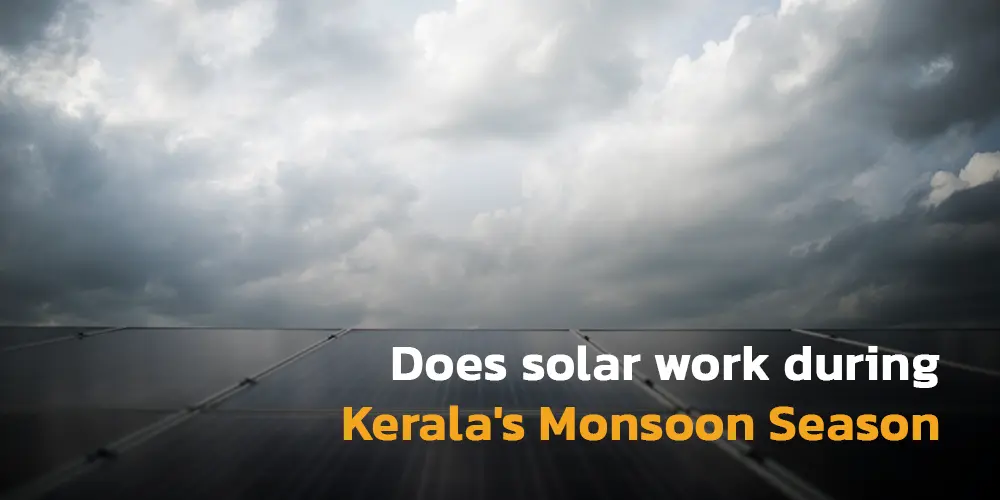
Solar Panels Work in the Rain/Monsoon Season
Let's get this straight from the start: solar panels do not need direct sunlight to generate electricity. They need light — specifically, photons.
When clouds roll in, sunlight scatters as diffuse light. It's softer, less intense, but it still carries photons. Those photons still hit your solar cells. The photovoltaic process still runs. You still generate power.
Output drops, yes - typically 15–30% during heavy overcast days in peak monsoon. But your system never goes to zero on a cloudy day unless it's fully dark. Even a drizzly Kerala afternoon produces measurable electricity from a well-installed system.
The more important number isn't what happens on your worst monsoon day. It's what happens across the full year. And annually, Kerala receives approximately 4.5 to 5.5 peak sun hours per day on average — enough to make solar one of the smartest investments a homeowner can make here.
What Actually Happens to Your Output Between June and September
Here's a realistic picture of what to expect month by month:
June: The Southwest Monsoon arrives. Cloud cover becomes consistent. Expect your daily output to drop to roughly 60–70% of peak capacity. Your system is still working — just at reduced load.
July–August: Peak monsoon. These are your lowest generation months. Output can dip to 50–60% of peak on heavily overcast days. This is entirely normal and already accounted for in every reputable system design.
September: Monsoon begins retreating. Sunshine returns in patches. Output starts climbing back.
October–November: Northeast Monsoon brings lighter, more intermittent rain. Generation is significantly better than the June–August period.
December–May: This is your solar golden period. Clear skies, high irradiance, and your panels running at or near peak capacity. These months more than compensate for the monsoon dip.
A well-designed solar system for a Kerala home is sized with all of this in mind. The surplus electricity you export to the grid during dry months earns credits that offset your monsoon bills. That's how net metering keeps your annual electricity cost close to zero.
One Thing Monsoon Actually Does for Your Panels
Here's something most people don't expect: rain is good for your panels.
Dust, pollen, bird droppings, and pollution film accumulate on panel surfaces during dry months. Even a thin layer of grime can cut efficiency by 5–7%. When the first monsoon rains arrive, they wash all of that off naturally — and clean panels absorb more light.
Think of the early monsoon as a free panel-cleaning service that runs for four months.
That said, heavy tropical rainfall combined with Kerala's humidity does require attention to a few things — which is why quality of installation matters enormously here.
Take advantage of government subsidies and reduce your electricity bills with rooftop solar.
Get Free ConsultationWhat Makes a Solar System Monsoon-Ready in Kerala
Not all installations are equal. In a high-rainfall, high-humidity climate like Kerala, the difference between a cheap installation and a properly engineered one shows up clearly during monsoon. Here's what a monsoon-ready system looks like:
Weatherproof junction boxes and wiring: All electrical connections must be IP65-rated or higher. Open or poorly sealed connections exposed to Kerala's humidity will corrode within two to three monsoon seasons.
Corrosion-resistant mounting structures: Your mounting frames live outdoors, fully exposed. Hot-dip galvanised or anodised aluminium structures resist rust even under sustained rainfall and salt-laden coastal air.
Proper panel tilt angle: In Kerala, panels are typically installed at 10 to 15 degrees. This isn't just for sun-angle optimisation - it also ensures rainwater runs off cleanly rather than pooling at the base, which can cause micro-cracking and long-term damage.
Battery or hybrid inverter setup: This is the real monsoon solution. A grid-tied system with battery backup stores surplus energy from sunny hours and delivers it when clouds cut generation. Even on your darkest monsoon day, stored power keeps your home running.
Monocrystalline panels over polycrystalline: Monocrystalline panels are significantly more efficient under low-light and diffuse conditions. In a monsoon climate, they consistently outperform cheaper polycrystalline alternatives.
The Power Backup Angle — Why Monsoon Is Actually an Argument For Solar
Here's the conversation most people haven't had yet.
Kerala's monsoon season doesn't just reduce solar generation. It also brings grid instability — frequent outages caused by fallen trees, flooded substations, and overloaded lines. If you've lived through a Kerala monsoon, you know that KSEB power cuts are more common, not less, during June–September.
A hybrid solar system with battery storage solves exactly this problem. While your neighbours are dealing with load-shedding, your home stays powered from stored solar energy. The monsoon - the very season people worry makes solar impractical is actually the season when solar with storage proves its value most dramatically.
This is why more Kerala homeowners are moving toward hybrid systems. The grid isn't your backup. Your battery is.
Conclusion
Solar works in Kerala's monsoon. Output dips, the way it does every winter for homeowners in colder climates — and then it comes back. Across a full year, Kerala's solar potential is outstanding, and the dry season surplus more than compensates for the monsoon months.
What matters most is how the system is designed, what components are used, and whether the installation is built for Kerala's specific climate. A system engineered for heavy rainfall, high humidity, and grid instability will serve you for 25 years with minimal issues.
The monsoon isn't a reason to delay going solar. For most Kerala families, it's actually a reason to go sooner — because the benefit of having backup power during the rainy season starts from day one.
Ready to find out exactly how much a Kerala-optimised solar system would generate for your home? Get a free site assessment from Best Solar Kerala.
Faq
1. How much does solar output drop during the Kerala monsoon?
On heavily overcast days, output typically drops 30–50% from peak. On partly cloudy days, the drop is 15–25%. Across the full monsoon season, most Kerala systems see a 20–30% reduction in monthly generation compared to the dry season. Annual output is still excellent.
2. Can solar panels handle heavy rainfall and strong winds?
Yes. Quality solar panels are tested to withstand sustained wind speeds of up to 130–150 km/h and are rated for heavy rain. Kerala's monsoon, even at its most intense, falls within safe operating parameters for certified panels.
3. Should I get a battery system if I'm in Kerala?
For most Kerala homeowners, a hybrid system with battery backup delivers the best return on investment. It solves both the monsoon generation dip and the grid outage problem in one installation.