If you've been shopping for rooftop solar in Kerala this year, chances are a vendor has already thrown the terms "DCR" and "non-DCR" at you — possibly without explaining what either actually means for your wallet. The confusion is real, and the stakes are higher than ever. A wrong choice here could cost you the entire ₹78,000 PM Surya Ghar subsidy, or worse, leave you scrambling to replace panels after MNRE tightened its rules in May 2026.
What Does DCR Actually Mean?
DCR stands for Domestic Content Requirement. A DCR-compliant solar panel is one where both the solar cells and the modules are manufactured in India. That's the key word — cells. A panel that's assembled in India using imported cells from China or Southeast Asia does not qualify as DCR, even if it carries an Indian brand name or ships in Indian packaging.
Non-DCR panels, by contrast, typically use imported solar cells , often from Chinese or Southeast Asian fabs — assembled into modules either abroad or domestically. Until recently, these were popular because they were cheaper and often more efficient (particularly N-type TOPCon and HJT technologies). In 2024 and early 2025, non-DCR panels were widely used in Kerala for commercial and private installations with no subsidy involved.
What Changed in 2026: The ALMM List-II Shake-Up
The Ministry of New and Renewable Energy (MNRE) issued a critical order on May 25, 2026, introducing the ALMM (Approved List of Models and Manufacturers) List-II, which specifically covers solar PV cells — not just modules.
Here's what that means in plain terms: from June 1, 2026, solar modules used in government linked projects — including PM Surya Ghar, PM-KUSUM, open access, and net-metered installations , must use cells sourced from the ALMM List-II, which exclusively covers domestically manufactured solar cells.
This is a major shift. Previously, ALMM List-I only covered modules. Now, the cell origin matters for subsidy eligibility, and the rule applies broadly to net-metered systems - which means it touches most residential and commercial solar installations connected to the KSEB grid in Kerala.
The Kerala Context: KSEB, Net Metering & Why This Matters
Kerala isn't your average solar market. The state gets 4.5 to 5.5 peak sun hours daily, which is lower than northern and western states, but KSEB's tiered domestic tariff — one of the highest in India for upper consumption slabs , makes solar ROI genuinely attractive for households consuming above 250 to 300 units per month.
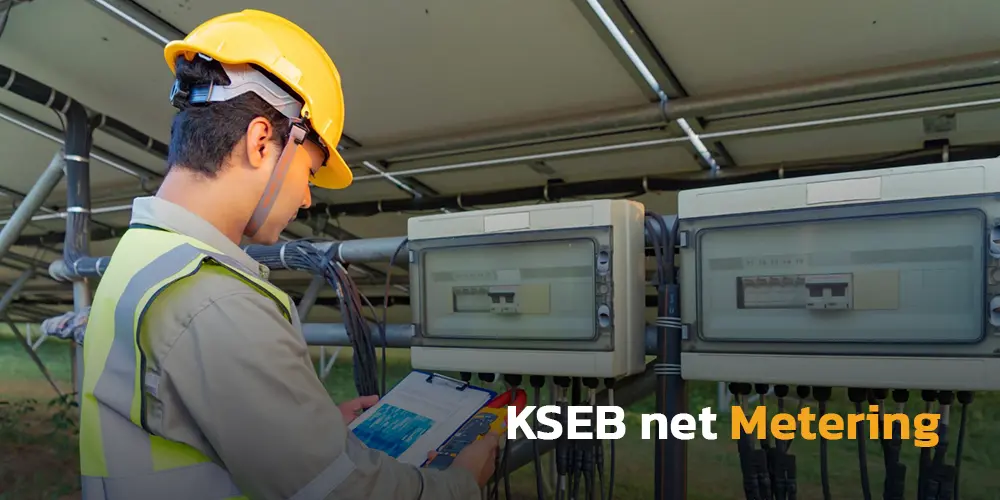
Under KSEB's net metering framework (governed by KSERC 2020 regulations, updated through 2026), surplus solar power is exported to the grid and adjusted against your import. KSEB settles banked units annually at a predetermined rate, and homes consuming significantly above their solar generation still save meaningfully. Kerala's rooftop solar capacity reached nearly 947 MW by late 2024, across over 1.52 lakh systems.
For all of these grid-connected, net-metered systems, the ALMM List-II mandate now applies. That means DCR compliance isn't just about subsidy anymore - it's increasingly tied to whether your installation can legally connect to the KSEB grid under net metering.
PM Surya Ghar Subsidy: The Numbers That Make DCR Worth It
Under the PM Surya Ghar Muft Bijli Yojana, the current Central Financial Assistance (CFA) structure for residential consumers is:
| System Size | Subsidy |
|---|---|
| Up to 2 kW | ₹30,000 |
| 2 kW to 3 kW | Additional ₹18,000 |
| Above 3 kW (capped) | ₹78,000 total |
To receive this subsidy, your panels must be DCR compliant, meaning Indian manufactured cells and modules and they must be listed on the MNRE ALMM list. Non-DCR panels immediately disqualify you from CFA, full stop.
Here's where the math becomes obvious: DCR panels in 2026 are priced roughly at ₹24–26 per watt, while non-DCR panels sit around ₹15 per watt. On a 3 kW system, DCR panels may cost approximately ₹20,000 to ₹25,000 more than non-DCR. But you receive ₹78,000 in subsidy by choosing DCR. The net benefit of DCR over non-DCR for a 3 kW system? Around ₹53,000 to ₹58,000 in your favour.
The "cheaper" non-DCR panel ends up being the expensive choice.
The "Give It Up" Option: When Non-DCR Is Still Legal
There is one legitimate path to installing non-DCR panels under the PM Surya Ghar framework in Kerala: the "Give It Up" option.
If a residential consumer chooses to voluntarily forgo the CFA subsidy, they can apply through the PM Surya Ghar National Portal without a DCR certificate. MNRE's clarification following the May 2026 order explicitly states that these consumers will also be exempt from the ALMM List-II requirement for solar cells - but only for projects commissioned up to March 31, 2027.
A few critical points about this route:
- It's irreversible. Once you submit a non-DCR "Give It Up" application, you cannot switch back and claim the subsidy later. There's no appeal or reversal window.
- You still need ALMM List-I compliance for the module (just not the cell separately).
- The exemption is limited to residential rooftop projects under PM Surya Ghar. All commercial, industrial, and non-scheme installations still need to comply with the full ALMM requirement.
- Applications must be submitted through the official PM Surya Ghar portal — there's no offline shortcut.
For most Kerala homeowners, especially those installing 3 kW systems where the subsidy is most impactful relative to system cost, "Give It Up" makes very little financial sense. It becomes worth considering only for larger systems (typically 5 kW and above) where the fixed ₹78,000 subsidy cap covers a smaller fraction of total system cost, and where access to high-performance imported TOPCon or HJT panels might offer long-term output advantages.
| Factor | DCR Panels | Non-DCR Panels |
|---|---|---|
| PM Surya Ghar Subsidy | ✅ Eligible (up to ₹78,000) | ❌ Not eligible |
| ALMM Compliance (post June 2026) | ✅ Compliant | ⚠️ Exempt only via "Give It Up" route until March 2027 |
| KSEB Net Metering Eligibility | ✅ Full eligibility | ⚠️ Conditional |
| Price per Watt (approx. 2026) | ₹24–26/watt | ₹15/watt |
| Technology Available | Mono PERC, N-type TOPCon (domestic) | TOPCon, HJT (imported) |
| Best For | Residential, subsidy seekers | Large private C&I, off-grid, no-subsidy projects |
What About Commercial and Industrial Installations in Kerala?
For businesses, factories, and commercial establishments in Kerala, the picture is more nuanced. If your installation involves net metering (which most commercial rooftop systems do), the ALMM List-II mandate applies post-June 2026. That pushes you toward DCR-compliant panels.
However, purely private commercial or industrial installations with no net metering, no government scheme, and no subsidy claim are currently not covered by the mandate. If you're installing a fully off-grid system for your business premises with zero grid interaction, non-DCR panels remain a legal option and may offer per-watt cost savings.
That said, most Kerala businesses install grid-tied systems for the operational flexibility and KSEB's 120% adjustment benefit for commercial net metering users. In those cases, ALMM compliance — and therefore DCR — is the prudent path.
How to Verify If Your Panels Are DCR-Compliant
1. Check MNRE's ALMM List at the official MNRE portal (mnre.gov.in) — search for both the module brand and the specific model number. A listed brand doesn't automatically mean every model is listed.
2. Ask for the DCR certificate — reputable installers and manufacturers will have this readily available. Hesitation here is a red flag.
3. Confirm cell origin — the cell manufacturer's name and country of origin should be documented in the technical datasheet. Indian-made cells from manufacturers like Adani Solar, Waaree, or Vikram Solar confirm DCR status.
4. Cross-check with your installer's MNRE empanelment — vendors registered under PM Surya Ghar are bound to supply ALMM-listed products. An empanelled vendor offering non-DCR panels for a subsidy scheme is a serious compliance violation.
Our Recommendation
For Kerala homeowners in 2026: if you're installing a rooftop system of up to 3 kW and claiming the PM Surya Ghar subsidy, DCR panels are non-negotiable. The subsidy advantage is too significant to give up, and the quality gap between domestic and imported panels has narrowed considerably - especially now that Indian manufacturers like Waaree, Adani Solar, and Vikram Solar produce efficient N-type TOPCon cells domestically.
For larger systems above 5 kW where the ₹78,000 subsidy cap covers less of your total project cost, a detailed financial analysis is worth doing. Sometimes the performance edge of imported TOPCon or HJT panels combined with lower per-watt cost can outweigh the subsidy gap - but this needs to be calculated case by case, not assumed.
Either way, the ALMM List-II rules mean that flying under the radar with non-DCR panels for net-metered systems is no longer a safe shortcut. Get it right from the start.
Frequently Asked Questions
Q1. Are DCR solar panels mandatory in Kerala for PM Surya Ghar?
Yes. If you're claiming the Central Financial Assistance (CFA) subsidy under PM Surya Ghar, DCR panels with ALMM-listed certification are mandatory. Non-DCR panels will disqualify your subsidy application.
Q2. Can I use non-DCR panels in Kerala without subsidy?
Residential consumers can use the "Give It Up" option on the PM Surya Ghar portal to install non-DCR panels without claiming CFA. This exemption is valid for systems commissioned before March 31, 2027, but it's irreversible — you cannot later switch back to claim subsidy.
Q3. Does the ALMM List-II order affect commercial solar installations in Kerala?
Yes, for commercial systems using net metering or any government scheme connection. Purely private off-grid commercial systems with no subsidy or grid involvement are currently exempt.
Q4. How do I check if my solar panels are DCR-compliant?
Verify the specific model number on the MNRE ALMM list, request the DCR certificate from your installer, and confirm the cell manufacturer's country of origin in the product datasheet.
Q5. What is the subsidy for a 3 kW solar system in Kerala in 2026?
Under PM Surya Ghar, a 3 kW residential solar system in Kerala qualifies for ₹78,000 in total subsidy — ₹30,000 for the first 2 kW plus ₹18,000 for the next 1 kW. DCR compliance is mandatory to receive this amount.
Looking to install a subsidy-eligible DCR solar system in Kerala? Best Solar Kerala offers MNRE-empanelled installations with genuine ALMM-certified panels. Get your free site assessment today.